By deanmina , 13 November 2025

The construction industry is constantly seeking methods to improve efficiency and reduce costs. For tasks like plastering, one of the most significant advancements is the shift from traditional manual application to machine application (often using spray plastering equipment). This change can dramatically cut down on labor expenditure—often achieving savings of up to 75%.

​The Labor Cost Challenge in Manual Plastering
By deanmina , 11 November 2025

Modern architectural ambition is frequently defined by fluid curves, dramatic cantilevers, and complex geometric forms. While these designs capture the imagination, they present a significant challenge to the building envelope: how to maintain thermal integrity using insulation systems primarily engineered for planar, orthogonal surfaces.

By deanmina , 8 November 2025

For architects and engineers operating across the Gulf Cooperation Council (GCC), material selection is less about short-term cost and entirely about long-term resilience. The region's unique climate—marked by punishing summer heat, intense UV exposure, high coastal humidity, and wind-driven sand—accelerates material degradation, often leading to premature failure of conventional building envelopes.

By deanmina , 7 November 2025

Selecting the optimal insulation system in the demanding Saudi climate requires a balanced evaluation of both established materials and modern, integrated solutions. The core decision often comes down to traditional Mineral Wool Panels versus advanced Perlite-based Thermal Plasters—a comparison that focuses on long-term performance and application efficiency, not just price.

By 6czpo , 6 November 2025

Choosing the right insulation for Saudi Arabian projects is a critical decision impacting energy efficiency, construction timelines, and long-term maintenance. As ThermalPlaster experts, we frequently encounter specifiers weighing our solution against traditional Mineral Wool (Rockwool/Glasswool) Panels.

This comparison highlights key factors to help architects and engineers justify their choice:

By 6czpo , 6 November 2025

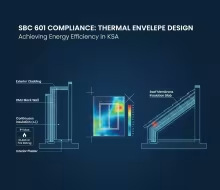
The Saudi Energy Conservation Code (SBC 601) represents a fundamental shift in KSA construction, mandating strict minimum energy-efficiency standards for the built environment. For architects and specifiers, compliance goes beyond simple adherence—it's an opportunity to design high-performance, sustainable, and lower-operating-cost structures.